
How to stop unauthorised parking on private land
Stopping unauthorised parking on private land in England and Wales means building an enforceable contract, not just putting up a sign. You need clear terms, proof of who parked and for how long, a lawful route to the registered keeper, and a notice served inside strict deadlines. Miss one and the charge falls apart. Scotland works differently again.
14 July 2026 / 8 min read
By Tim Marting, Head of International Business Development
What counts as unauthorised parking on private land
Unauthorised parking on private land covers any vehicle using a space without permission: commuters leaving cars all day, shoppers from a neighbouring business, non customers, fly parkers who dump vehicles overnight, and caravans left for weeks. The real issue is rarely a single driver. It is that the site cannot tell who is allowed to be there.
Most site owners picture unauthorised parking as a one off, a stranger who pulled in and left. In practice it is usually a pattern. The same commuters take the same spaces every weekday because nothing stops them, and once word gets round that a car park is free to use, the numbers only grow.
Retail and hospitality sites see overspill from next door, especially where nearby free parking has been removed or restricted. Industrial yards and rural land attract fly parking and caravans left for weeks at a time, often on ground the owner rarely walks.
The common thread is that none of these sites can separate a permitted vehicle from one that should not be there. That is a systems problem rather than a people problem, and it is the same gap a car park management system is built to close.
Is unauthorised parking illegal, and can the police help?
In England and Wales, unauthorised parking on private land is a civil matter, not a criminal offence, so the police will not normally attend. Clamping or towing a vehicle without lawful authority is itself a criminal offence. The lawful route is a contract formed through clear signage, which allows a parking charge when the terms are breached.
If you have already rung the police and been told this is a civil matter, that was correct, and it will not change however many times you call. Officers have no power to move, ticket or fine a vehicle simply because it is parked where it should not be.
That leaves clamping and towing looking like the obvious answer, and it is best to be blunt here. Doing either without lawful authority is a criminal offence under the Protection of Freedoms Act 2012, so the frustration is understandable and the option is closed.
The lawful route is a contract rather than a confrontation. Terms displayed on site, breached by the driver, create a parking charge that can be pursued through the civil courts if it goes unpaid.
Scotland sits outside that framework. The Protection of Freedoms Act does not apply there, so there is no automatic keeper liability and a charge rests on contract law against the driver rather than the registered keeper. Part 8 of the Transport (Scotland) Act 2019 would extend liability to the keeper, but it is not yet in force, so a Scottish site needs to identify the driver.
Why a sign on its own stops very little
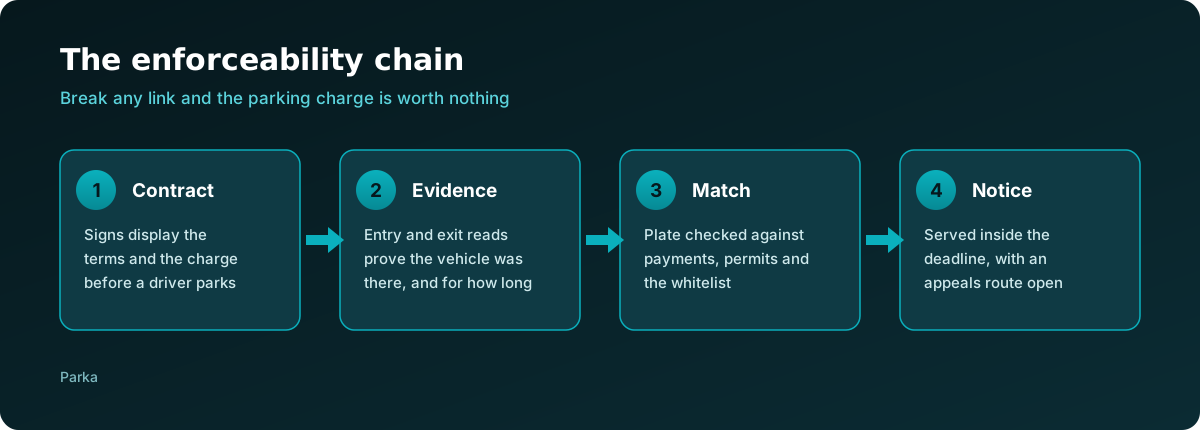
A sign creates the contract, but it enforces nothing by itself. You also need evidence of when a vehicle arrived and left, a lawful route to the registered keeper, a notice served inside strict deadlines, and a fair appeals process. Break any link in that chain and the charge is unenforceable.
This is the part most advice leaves out, and it is why so many landowners put up a sign, wait, and find nothing has changed. The sign was only ever the first link.
Proof comes next. A single photograph of a parked car says almost nothing, because the charge usually turns on how long the vehicle stayed, not that it was there at one moment. Timestamped entry and exit reads are what turn a complaint into evidence.
Then comes the question of who you can lawfully chase. If the driver cannot be identified, the registered keeper can only be pursued through an accredited route, and only if the paperwork lands inside the deadline. Courts treat a late or incomplete notice as fatal, not as a technicality to be waved through.
So the sign is necessary and nowhere near sufficient. What actually works is parking access and control as a chain: terms, evidence, identification, notice and appeal, each link holding the next one up.
The 4 ways to control it, and what each one really does
There are 4 practical ways to control unauthorised parking: signage with self ticketing, wardens on patrol, barriers that control entry and exit, and ANPR cameras that read every plate. All 4 work. The right one depends on the size of the site, its layout, and how often it needs watching.
A private road or a small yard is not a large retail car park, and matching the method to the site matters more than buying the most advanced thing on the shelf.
Self ticketing suits low traffic sites where hardware is hard to justify, though it only works if somebody walks the site consistently. Wardens bring judgement a camera cannot: they spot the driver in genuine difficulty and settle a dispute on the spot. Their limit is coverage, because a site is only protected for the hours somebody is there.
Barriers and access control stop the vehicle at the entrance instead of arguing with it afterwards, which suits sites where keeping people out matters more than charging them later. Parka supplies and supports both barriers and compliant signage, because the strongest setups pair a physical stop with terms a court will uphold.
For larger or higher turnover sites, reading every plate does more with far less daily effort, which is where the next option earns its place.
| Method | Best suited to | What it really does |
|---|---|---|
| Signage and self ticketing | Private roads, small yards, low traffic sites | Creates the contract and the deterrent. Cheapest to start, but somebody still has to walk the site and catch the breach. |
| Wardens on patrol | Busy or high risk sites, event days | Human judgement and a visible presence. Disputes settled face to face. Protection lasts only as long as the shift. |
| Barriers and access control | Sites where the priority is keeping the wrong vehicle out | A physical stop at the entrance. Strong on its own, stronger when the arm lifts for a plate that holds a permit or has paid. |
| ANPR cameras | Larger car parks, high turnover, open or free flow sites | Every plate read on entry and exit, matched to a permit or a payment. Works 24 hours a day and builds the evidence trail. |
How ANPR turns unauthorised parking into something you can act on
ANPR cameras read every plate on entry and exit and match it against payments, permits and whitelists for staff, residents, contractors and genuine guests. Grace periods cover drop offs and wrong turns without a charge, and every read is timestamped, which gives you the evidence trail a charge needs if it is appealed.
This is the point where unauthorised parking stops being a guessing game. Rather than a warden happening to notice a vehicle, the site itself knows what is on it and how long it has been there.
Parka's ANPR cameras capture every plate and cross check it against who has paid and who holds a permit, so the people who belong on site move through without ever being treated as a problem. The exceptions are where operators get the most value: one rule for staff, another for contractors, another again for a guest already charged at the front desk, all held against the same record and none of it needing a paper permit on a windscreen.
Paying has to be easy for the visitors you want, which is why payment kiosks and the Parka app sit alongside the cameras rather than behind them. A driver who can pay in seconds rarely becomes a dispute.
And when a charge is challenged, which it will be, the answer is a timestamped record of an arrival, a departure and a payment that never happened, rather than somebody's recollection of a Tuesday afternoon.
What it costs, and why you keep being offered it for free
Parka works with operators however suits them, and the structures are set out plainly in our funding models guide on this site; most sites start without treating it as a capital project. Bought outright, the spread between a simple site and a complex one is an order of magnitude, before the monthly software, which is why our cost guide prices the parts rather than promising a single figure.
What moves that number is the mix a site actually needs. Cameras, barriers, kiosks, signage, EV charging, the groundworks and power to feed all of it, connectivity, and the software and support that hold it together. A single entry road and a multi storey car park have almost nothing in common, and a quote that ignores the difference is not a quote worth reading.
If you have been offered car park management for nothing, look twice rather than saying yes. Somebody is always paid in this industry, whether out of the charges issued to drivers, a share of the takings, or a fee sitting further down the contract. That is not a scandal, it is a business model, and it can be a perfectly good one.
Parka puts the model in writing for exactly that reason. A landowner should be able to see who earns what and when before signing anything, and our own preference is a structure where Parka does well only when the site does.
| Cost factor | What drives it |
|---|---|
| ANPR cameras | How many entrances and exits need covering, and how hard the reads are at night, at an angle or in bad weather. |
| Barriers and access control | Whether the site wants a physical stop as well as a record. Barriers sit alongside recognition rather than being replaced by it. |
| Payment kiosks | How many on site payment points the car park needs, and whether cash is still taken. |
| Signage | Signs form the contract, so quantity, placement and compliance with the Code of Practice all feed the cost. |
| EV charging | If chargers are on site, the same platform can manage bay use and stop charging bays being used as free parking. |
| Groundworks and power | Trenching, ducting, posts and power to every camera and barrier. Often as expensive as the equipment itself. |
| Connectivity | A remote site with weak coverage needs its own connection before a plate read can reach anything. |
| Software and support | Payments, permits, whitelists, reporting, appeals and the people behind them. This is what turns a plate read into revenue. |
Got a car park being used by people who should not be there?
Book a 30 minute demo and we will walk you through the platform and shape a model that fits your site.
Book a demo →Getting it right without punishing your genuine visitors
A Notice to Keeper must be served within 14 days, or 29 days where a notice was left on the windscreen, and the keeper cannot be pursued until 28 days after that. DVLA keeper records cost £2.50 each and require BPA or IPC membership. Private parking charges are commonly capped at £100.
The rules are strict on purpose. A private operator can pursue money from a stranger over a vehicle, so the process that allows it is tightly drawn, and the courts hold operators to it rather than making allowances.
The sector is also under more scrutiny than it used to be. The two accreditation bodies now run a joint industry code with a hard 2026 compliance deadline, covered properly in our guide to choosing a car park management company, and a separate government code is still pending. Operators issued 4.3 million parking charge notices between April and June 2025, so this is an industry running at real scale, not a niche corner of the law.
Getting the mechanics right is only half the job. A sensible grace period, a whitelist for staff, residents, contractors and booked guests, and an appeals route that a reasonable person would call fair are what keep an enforceable system from becoming an unfair one.
Do it properly and the bays go back to the people they were built for. The site stops leaking value to vehicles that were never meant to be there, and a car park that has been a running cost for years starts funding its own upkeep.
Common questions
Can I clamp or tow a car parked on my private land?
No. Clamping or towing a vehicle without lawful authority is a criminal offence in England and Wales, however long the vehicle has been there. The lawful route is a parking charge built on a contract formed by clear signage, pursued through the civil courts if the driver does not pay.
Can the police remove a car parked on my land without permission?
Not normally. Unauthorised parking on private land is a civil matter in England and Wales, not a criminal one, so the police will not attend or remove a vehicle simply because it is parked without permission. Your route is a lawful parking charge backed by compliant signage.
Do I need signs before I can issue a parking charge?
Yes. A parking charge is only enforceable if a contract existed between the driver and the landowner, and that contract is formed by clear signage setting out the terms and the charge before the vehicle parks. With no compliant signage in place first, there is no contract to breach and no charge to issue.
Can I find out who owns a vehicle parked on my land?
Only through the proper route. Where the driver cannot be identified, an operator may apply to the DVLA for the registered keeper's details, but only as a member of the British Parking Association or the International Parking Community, and only with reasonable cause. Each record costs £2.50.
More insights
Have a closer look when you are ready
Book a 30 minute demo and we will walk your team through the platform at your pace.