
How airports cut drop off congestion with ANPR
Airport drop off management used to mean a barrier, a ticket machine, and a queue of cars idling behind whoever cannot find change. That is not management, it is triage. Real drop off management uses number plate recognition to read every vehicle at the kerb, price the time it stays, and take payment after the visit. No ticket, no barrier, no scramble for coins. The plate does the paperwork and the lane keeps moving.
13 July 2026 / 7 min read
By Tim Marting, Head of International Business Development

Why airport drop off zones seize up
Drop off zones seize up because dwell time goes unmanaged. Without automatic entry and exit reads, staff cannot see how long each vehicle has been at the kerb, so a car that is done in 30 seconds sits behind one that has been there for 10 minutes. Congestion builds within minutes at the busiest arrival and departure times.
Flights bunch together. When several aircraft land inside the same short window, the forecourt gets the same treatment: a rush of cars all wanting the same stretch of kerb at once.
A single lane cannot absorb that if every car sits at the kerb for minutes rather than seconds. Add a driver waiting on a passenger whose bag has not appeared yet, and the tailback reaches the roundabout before anyone notices.
This is why airport landside teams increasingly treat the drop off zone as a capacity problem first and a revenue problem second. Get the flow right and the charging model follows naturally.

How ANPR drop off management actually works
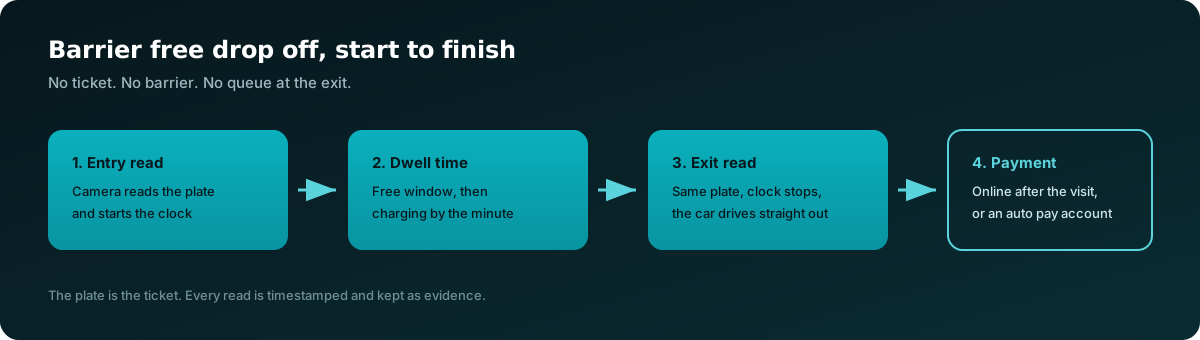
ANPR drop off management uses cameras to read a vehicle plate on entry, log the time, and read it again on exit. There is no ticket to take and no barrier to lift. The system calculates dwell time automatically and either charges through an account or invoices the driver after the visit, based on the plate alone.
The entry read starts the clock, the exit read stops it. Everything in between, the pricing tier, the grace period, the discount for a blue badge, sits in software rather than in a machine at the kerb.
Manchester went barrier free at its drop off and pick up zones in a phased rollout from 26 March 2025, leaving no payment barriers or machines in the zones at all. Stansted did the same at its Express Set Down area in January 2025, with drivers paying online or by phone by midnight the day after the visit.
The camera read is only one input. Some operators let drivers confirm which site or zone they used through an app rather than relying on the plate alone, which matters at busy sites with more than one entrance. Our ANPR cameras pair with a mobile app for exactly that reason, giving drivers a second way to identify themselves when a plate read is unclear.
Why the barrier is the bottleneck
The barrier itself is the bottleneck because every vehicle has to stop, interact with a machine, and wait for the arm to lift, even when all it is doing is confirming what a camera already knows. Remove the stop and the same lane can process more vehicles in the same amount of time.
A barrier is a mechanical promise that no one leaves without paying. On a quiet car park that promise is worth the wait. On a forecourt handling a constant stream of cars, it is the single biggest source of delay in the whole journey.
What is the barrier actually protecting against on a kerb where the visit is over in minutes? The bigger risk on a fast moving forecourt is queuing traffic backing onto the approach road, not the rare driver who slips through without paying.
None of this makes barriers obsolete. Barriers and access control do the job well on long stay car parks, staff parking and any site where dwell times run into hours rather than minutes, and they pair with recognition rather than competing with it. Barrier free suits a busy forecourt, a barrier suits a car park where the vehicle stays put. Parka supplies and supports both, and helps operators work out which lanes need which.
Pricing dwell time without punishing the passenger
Airports price dwell time without punishing ordinary passengers by keeping a short, genuinely free window for a quick goodbye, then charging only once a car stays longer. Blue badge holders, local residents and registered taxi accounts are typically exempted or discounted, so the charge falls on congestion rather than on every driver who uses the kerb.
Birmingham still offered 10 minutes free as of mid 2026, but in a separate Drop Off car park 5 to 10 minutes' walk from the terminal, with a no return within 1 hour policy. Dropping off at the terminal itself, in Premium Set Down, costs £7 for the first 15 minutes. Most charging airports build in some version of that idea, whether it is a short free period at the main kerb or a separate free zone entirely.
Stansted keeps a free drop off at its Mid Stay car park, a short distance from the terminal, with a free shuttle bus. Manchester runs a free drop off at JetParks 1 with a 24 hour shuttle. Heathrow keeps a free drop off at its Park and Ride car parks, previously known as Long Stay. None of these airports rely on the paid kerb as the only way in.
Blue badge holders get a 100% discount at Heathrow and are exempt from its 10 minute maximum stay. Frequent users, taxi drivers included, can register an account at several airports so payment happens automatically instead of one transaction at a time. That is the fairness case in practice: charge the driver who occupies the kerb for a long stop, not the one collecting a wheelchair user in 3 minutes.
Want to see what this looks like on your forecourt?
Book a 30 minute demo and we will walk you through the platform and shape a model that fits your airport.
Book a demo →What a drop off system costs to build
The honest answer is a spread wide enough to be useless without a survey: a small single lane site and a multi terminal airport differ by an order of magnitude, before the monthly software. That covers cameras, barriers or barrier free infrastructure, kiosks, signage and enforcement, and our ANPR system cost guide on this site breaks the whole figure down piece by piece.
That is the market shape, and it rarely reflects what an operator pays from their own pocket. Parka works with operators however suits them, and the funding structures are laid out plainly in our guide to how free car park management models work. A forecourt that funds itself from day one is the normal outcome, not the exception, so if the market range looks out of reach, talk to our team about a model that offsets the setup instead of asking you to fund it in one go.
What moves the number is the site, not a price list. The factors below are the ones that actually shift a forecourt build, from how many lanes need recognition to whether EV charging and digital signage are part of the same project, all tied together by the payment and operator platform behind it.
A single lane forecourt at a regional airport sits at the low end. A multi terminal hub with several forecourts, shared enforcement and its own app integration sits at the top, because of scale rather than any one piece of kit being disproportionately expensive.
| Factor | Why it matters |
|---|---|
| Lanes and camera coverage | Every entry and exit point needs its own recognition coverage, so a multi lane forecourt carries more hardware than a single lane kerb. |
| Camera type and read accuracy | A forecourt camera has to read plates at an angle, in rain, at night and under canopy lighting. Read accuracy is what keeps a lane moving and a charge defensible. |
| Barriers and access control | Optional on a fast kerb, valuable on long stay and staff car parks. Barriers sit alongside recognition rather than being replaced by it. |
| Kiosks and digital signage | Clear signage tells drivers what the charge is and that a camera is in operation. Kiosks give an on site payment route for anyone who wants one. |
| EV charging bays | If the forecourt or nearby car park carries chargers, the same platform can manage bay use and stop charging bays being used as free parking. |
| Payment and software platform | This is what turns a plate read into revenue: dwell pricing, free windows, discounts, auto pay accounts and the reporting behind them. |
| Enforcement and appeals | A charge is only worth issuing if it stands up. The audit trail, the notice process and the appeals route are part of the build, not an afterthought. |
| Integration with existing systems | Terminal car parks, staff permits and existing barriers usually already exist. What it costs depends on how much has to talk to what is already there. |
Cloned plates, appeals and getting enforcement right
Getting enforcement right means being able to prove a vehicle was actually on site when a charge was issued, because plate cloning and ghost plates are a real and growing problem. A clean audit trail, a fair appeals process and sensible grace periods protect genuine drivers while still recovering money from cars that overstay.
MPs raised exactly this in a Westminster Hall debate on airport drop off charges on 13 January 2026, when one MP reported constituents fined after their number plates were cloned. That is not a small operational detail. It is the difference between a system drivers trust and one they fight.
Heathrow drivers who miss the payment deadline risk a Parking Charge Notice of £80. A figure like that only holds up if the operator can show, read by read and timestamp by timestamp, that the vehicle in question really did use the kerb for the time being charged.
That is what an audit trail is for. Every entry and exit read, every payment attempt and every appeal outcome needs to sit in one place, so that when a driver disputes a charge it gets resolved in minutes rather than escalating into the kind of story that ends up in Parliament.
The data an airport gets back from the kerb
Every plate read builds a live picture of the forecourt: dwell time by vehicle, arrival peaks by hour, the mix of drop off traffic against long stay car park use, and how passengers are actually reaching the airport. That data feeds staffing, capacity planning and the case for non aeronautical revenue.
The CAA's Departing Passenger Survey found that in 2024, 63% of passengers leaving the 8 largest UK airports arrived by private transport, 39% by car and 24% by taxi. Numbers like that used to come from occasional passenger surveys. A recognition system produces the same picture every day, automatically, without asking a single passenger a question.
Staffing is usually the first thing to change. A landside team that can see the shape of tomorrow morning knows which lanes need a marshal at first light and which do not, instead of covering every hour equally in case. The free window gets the same scrutiny, because the reads show whether drivers treat it as a quick goodbye or as free parking. A Stansted spokesperson called kiss and fly the least sustainable way of reaching an airport, involving 4 car journeys per flight, and the kerb is where an airport finds out whether it is shifting that or not.
None of it is useful sitting in a spreadsheet nobody opens. It needs to be somewhere landside managers actually look, ideally a data dashboard that turns raw plate reads into the kind of report that goes straight into a board pack.
Common questions
How do airports know how long a car stayed in the drop off zone?
A camera reads the number plate on entry and again on exit, and the system calculates the time between the 2 reads automatically. There is no ticket and no manual check. This is how barrier free zones such as Manchester and the Stansted Express Set Down area track dwell time and work out any charge due.
Do airports still need barriers on the drop off forecourt?
Not necessarily on the main kerb, where speed matters more than a physical stop. Barriers still make sense on long stay car parks, staff parking and any site where vehicles remain for hours rather than minutes, because the few seconds spent waiting at an arm matters far less there.
What happens if a driver does not pay an airport drop off charge?
Most airports give a payment window, often until midnight the day after the visit, before issuing a Parking Charge Notice. At Heathrow that notice is £80. Operators need a reliable record of the plate read, the timestamp and any appeal, because drivers increasingly dispute charges linked to cloned or misread plates.
Can an airport keep a free drop off option and still manage congestion?
Yes, and most already do. Stansted, Manchester and Heathrow all pair a paid, time limited kerb with a free alternative such as a longer stay car park or a shuttle. The free option absorbs drivers who are not in a hurry, which keeps the paid kerb clear for fast, genuine drop offs.
More insights
See what your kerbside is really doing
Book a 30 minute demo and we will show you the platform on real drop off and forecourt patterns.